
Civil Rights
Frederick Douglass: Transforming America
Mar
Frederick Douglass was one of the most influential figures in American history. Born into slavery, he escaped and became a leading voice in the abolitionist movement, an advocate for equality, and a champion of civil rights. His writings, speeches, and relentless activism helped shape the fight for justice and freedom in the 19th century and beyond. His legacy continues to inspire those who seek equality and social justice today.
Early Life and Enslavement
Frederick Douglass was born as Frederick Augustus Washington Bailey in February 1818 in Tuckahoe, Maryland. The exact date of his birth remains unknown, though he later chose to celebrate it on February 14. Douglass was born into slavery, and like many enslaved children, he was separated from his mother, Harriet Bailey, at an early age. He saw her only a few times before her death. His father was believed to be a white man, possibly his enslaver, though the identity remained uncertain.
At a young age, Frederick Douglass was sent to Baltimore to work for the Auld family. There, Sophia Auld began teaching him the alphabet, an unusual act for enslaved people at the time. However, when her husband, Hugh Auld, discovered this, he forbade her from continuing, arguing that education would make Douglass unfit for slavery. This moment was a revelation for Douglass. He realized that knowledge was the key to freedom, and he secretly taught himself to read and write.
Escape from Slavery
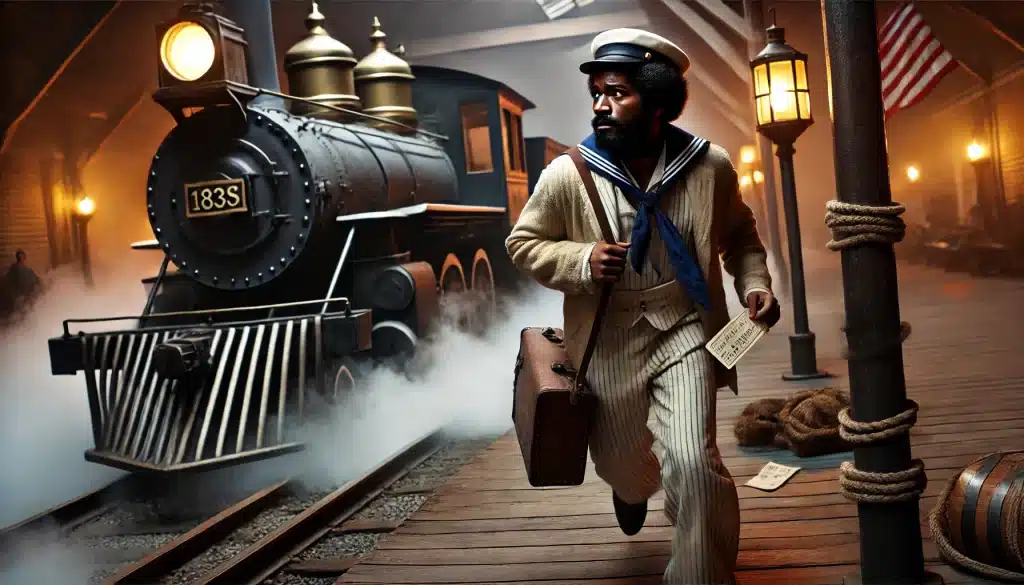
Determined to break free from bondage, Douglass made several attempts to escape before finally succeeding in 1838. He disguised himself as a sailor and borrowed papers from a free Black man to travel from Maryland to New York. Once free, he married Anna Murray, a free Black woman who helped him escape, and the couple settled in New Bedford, Massachusetts. He changed his surname to Douglass, inspired by a character in Sir Walter Scott’s poem The Lady of the Lake.
Rise as an Abolitionist Leader
In New Bedford, Frederick Douglass found work as a laborer but quickly became involved in the abolitionist movement. He began attending meetings and, in 1841, spoke at an anti-slavery convention organized by William Lloyd Garrison’s American Anti-Slavery Society. His powerful speech and eloquence amazed the audience, launching his career as a speaker and writer.
He soon published his first autobiography, Narrative of the Life of Frederick Douglass, an American Slave, in 1845. The book detailed his experiences under slavery and became a bestseller, further solidifying his role in the abolitionist movement. However, its success also put Douglass at risk of being captured and returned to slavery. To ensure his safety, he traveled to Ireland and Britain, where he spoke against slavery and gained financial support from British abolitionists, who ultimately helped purchase his legal freedom in 1846.
The North Star and Advocacy for Equality
Upon returning to the U.S., Douglass established his own anti-slavery newspaper, The North Star, in Rochester, New York, in 1847. The newspaper’s motto, “Right is of no sex, Truth is of no color, God is the Father of us all, and we are all brethren,” reflected Douglass’s commitment to universal human rights.
Beyond his work as an abolitionist, Douglass became a vocal advocate for women’s rights. He attended the Seneca Falls Convention in 1848, supporting Elizabeth Cady Stanton and other suffragists in their call for women’s right to vote. Frederick Douglass believed the fight for equality should extend beyond race to gender.
Role in the Civil War
As tensions over slavery escalated, Douglass played a significant role in advocating for the use of Black soldiers in the Civil War. When the war broke out in 1861, he pushed President Abraham Lincoln to allow Black men to enlist in the Union Army. His efforts paid off in 1863 when Lincoln issued the Emancipation Proclamation and authorized recruiting of Black soldiers.
Frederick Douglass helped recruit African American troops, including his sons, for the 54th Massachusetts Infantry Regiment. He also met with Lincoln several times to discuss issues such as fair treatment and equal pay for Black soldiers. Although he initially criticized Lincoln for being slow to act on slavery, Douglass later praised him for his role in its abolition.
Post-War Contributions and Government Service
Following the Civil War, Douglass continued to fight for civil rights. He pushed for Reconstruction policies to ensure equal rights for newly freed African Americans, including voting rights and legal protections. However, as Reconstruction ended and racial discrimination persisted, Douglass grew frustrated with the nation’s failure to live up to its promises of equality.
Despite these challenges, Douglass remained active in public life. He was appointed to several government positions, including U.S. Marshal for the District of Columbia, Recorder of Deeds for Washington, D.C., and Minister to Haiti. Through these roles, Frederick Douglass continued advocating for justice despite facing significant opposition and racism.
Legacy and Impact
Frederick Douglass passed away on February 20, 1895, at 77. His death marked the end of a life dedicated to pursuing freedom, justice, and equality. However, his influence did not end with his passing. His writings, speeches, and activism laid the foundation for future civil rights movements, including the 20th-century struggle for racial justice led by figures like Martin Luther King Jr.
Douglass’s legacy remains alive today. His words on justice, education, and perseverance continue to resonate, reminding us of the ongoing fight for equality. His home in Washington, D.C., is preserved as a National Historic Site, and his contributions are studied in schools and honored nationwide.
Conclusion
Frederick Douglass was more than an abolitionist; he was a visionary leader, a champion of human rights, and a voice for the oppressed. His journey from slavery to international prominence is a testament to the power of resilience, education, and activism. Through his legacy, he reminds us that the fight for justice is never over and that each generation must continue the struggle for equality and human dignity.
His story is a powerful lesson in courage, determination, and the belief that no obstacle is too great to overcome. Frederick Douglass once said, “If there is no struggle, there is no progress.” His life is a beacon of hope for all seeking a more just and equal world.
