
Founding Fathers, Presidents
Thomas Jefferson Visionary of the American Republic
Dec
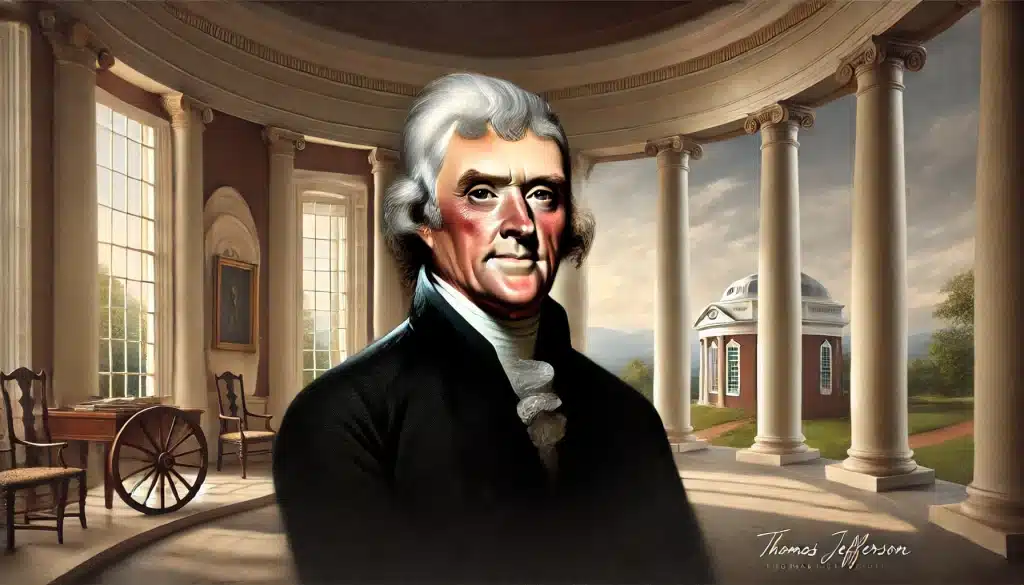
Thomas Jefferson, the third President of the United States (1801–1809), remains one of American history’s most revered yet complex figures. Known as the principal author of the Declaration of Independence, Jefferson was a statesman, diplomat, philosopher, and visionary who profoundly shaped the young nation’s political, cultural, and intellectual landscape. His presidency, political philosophy, and personal contradictions make him a fascinating study of leadership, ideals, and the realities of governance.
Early Life and Education
Thomas Jefferson was born on April 13, 1743, in Shadwell, Virginia, and grew up in a prosperous plantation-owning family. His father, Peter Jefferson, was a planter and surveyor, while his mother, Jane Randolph Jefferson, hailed from one of Virginia’s most distinguished families. These affluent beginnings provided young Jefferson with access to a rigorous education.
Jefferson’s passion for learning was evident early in life. He attended the College of William & Mary, where he excelled in mathematics, philosophy, and classical studies. Under the mentorship of Dr. William Small, Jefferson developed a deep interest in the Enlightenment, which shaped his worldview and political ideals. His legal studies under George Wythe, a prominent lawyer, prepared him for a career in law and politics.
Jefferson’s Role in the American Revolution
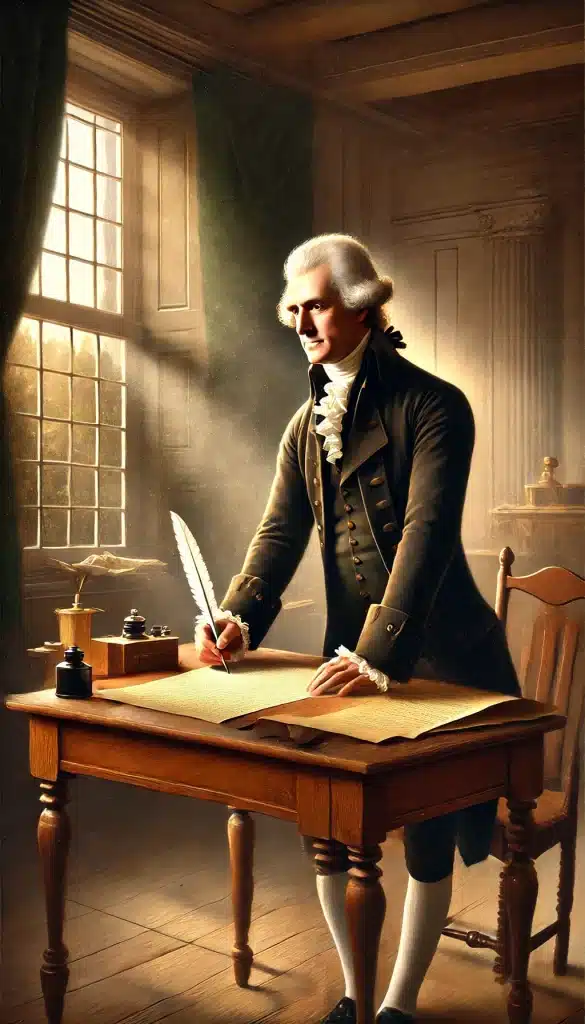
Jefferson’s entry into public service coincided with the burgeoning tensions between the American colonies and Great Britain. In 1776, he was a delegate to the Second Continental Congress and was tasked with drafting the Declaration of Independence. His eloquent prose articulated the colonies’ grievances and the vision of liberty, equality, and self-governance.
The Declaration’s most famous passage—asserting that “all men are created equal” and endowed with “unalienable Rights” to “Life, Liberty and the pursuit of Happiness”—has become a cornerstone of American identity. However, Jefferson’s own life as a slave owner starkly contradicted these ideals, a paradox that continues to provoke debate about his legacy.
Jefferson, as a Political Theorist
Jefferson’s political philosophy was rooted in Enlightenment ideals. He championed individual liberty, limited government, and the separation of church and state. As an advocate of agrarianism, Jefferson believed that a republic founded on independent farmers would best preserve democratic principles.
His opposition to centralized authority defined his political career. Jefferson clashed with Federalists, such as Alexander Hamilton, over the scope of federal power. He co-founded the Democratic-Republican Party, which advocated for states’ rights and a strict interpretation of the Constitution.
The Presidency: Achievements and Challenges
Thomas Jefferson’s presidency marked a transformative period in U.S. history, with significant achievements and formidable challenges.
The Election of 1800
Jefferson’s election in 1800, often called the “Revolution of 1800,” was a pivotal moment in American politics. The peaceful transfer of power from John Adams of the Federalists to the Democratic-Republicans demonstrated the resilience of the young republic’s democratic institutions. Jefferson’s victory reflected the growing appeal of his vision for a more decentralized government.
The Louisiana Purchase
Jefferson’s most significant presidential accomplishment was the Louisiana Purchase of 1803. The acquisition of this vast territory from France doubled the size of the United States and opened new opportunities for westward expansion. Although the purchase conflicted with Jefferson’s strict constitutional principles, he justified it as a pragmatic decision for the nation’s benefit.
Lewis and Clark Expedition
Thomas Jefferson commissioned the Lewis and Clark Expedition (1804–1806). to explore the newly acquired Louisiana Territory. This ambitious endeavor expanded geographic knowledge, strengthened claims to the western frontier, and established relationships with Native American tribes.
Challenges of Foreign Policy
Thomas Jefferson’s presidency was marked by complex foreign policy challenges, particularly involving Britain and France. The Napoleonic Wars disrupted American trade, leading Jefferson to implement the Embargo Act of 1807. Although intended to avoid war by restricting trade with warring nations, the embargo severely harmed the U.S. economy and proved unpopular, especially among merchants.
Personal Life and Interests
Jefferson’s personal life reflected his multifaceted interests and contradictions. At Monticello, his Virginia plantation, he pursued his passions for architecture, agriculture, and innovation. He designed Monticello to reflect his Enlightenment ideals, blending beauty, utility, and harmony with nature.
However, Monticello also symbolizes the contradictions of Jefferson’s life. As a slave owner, he relied on enslaved labor to sustain his estate, even as he expressed philosophical opposition to slavery. Jefferson’s relationship with Sally Hemings, an enslaved woman at Monticello, has been the subject of historical scrutiny and debate.
Legacy and Controversies
Contributions to American Ideals
Jefferson’s contributions to the founding principles of the United States are undeniable. His advocacy for democracy, individual rights, and education has left an indelible mark on the nation’s identity. The University of Virginia, which Jefferson founded in 1819, exemplifies his commitment to public education and intellectual inquiry.
The Paradox of Slavery
His role as a slave owner complicates Jefferson’s legacy. Despite his expressed opposition to slavery as a moral and political evil, he owned more than 600 enslaved individuals during his lifetime. This contradiction has prompted ongoing debates about reconciling Thomas Jefferson’s ideals with his actions.
Modern Reassessment
In recent decades, scholars and activists have reassessed Thomas Jefferson’s legacy in light of his contradictions. Monuments and institutions bearing his name have sparked discussions about historical memory, justice, and representation.
Jefferson’s Enduring Influence
Thomas Jefferson’s impact on the United States extends far beyond his presidency. His ideas continue to inspire debates about the role of government, the meaning of liberty, and the pursuit of equality. As a symbol of aspiration and imperfection, Jefferson challenges Americans to reflect on the nation’s founding ideals and ongoing evolution.
Conclusion
Thomas Jefferson’s life and legacy embody the complexities of the American experiment. As a statesman, philosopher, and leader, he articulated a vision of liberty and democracy that has shaped the nation’s identity. Yet, his contradictions as a slave-owning advocate of freedom remind us of the ongoing struggle to reconcile ideals with realities.
Thomas Jefferson’s story is not just a tale of the past but a mirror of the present. His achievements inspire us to strive for a more just and equitable society, while his flaws compel us to confront the persistent inequalities. Understanding Jefferson enables us to gain a deeper appreciation of the challenges and possibilities of the American journey.
OpenAI. (2024). ChatGPT [Large language model]. https://chatgpt.com
