
Founding Fathers, Presidents
John Adams: The Second President of the United States
Dec
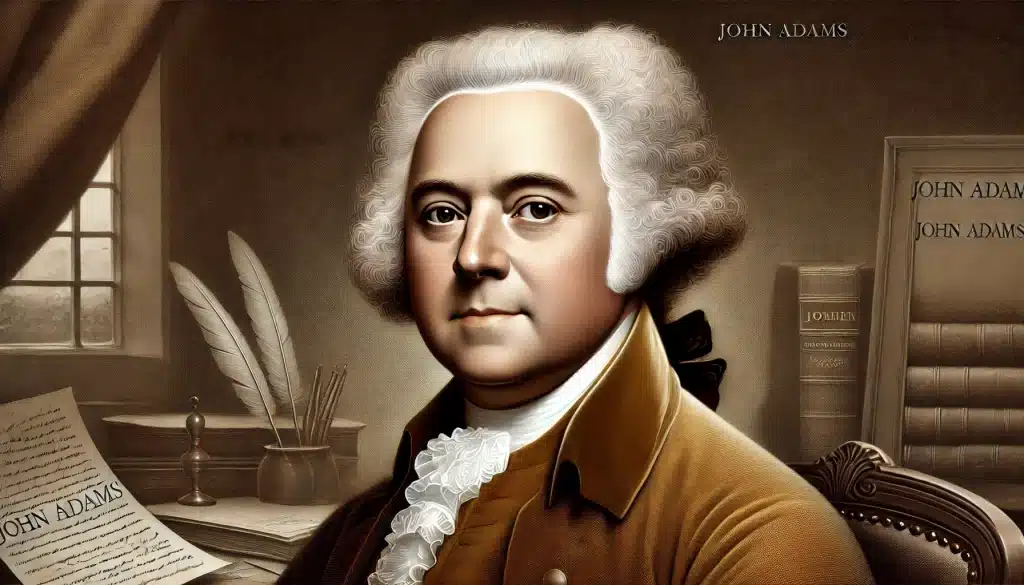
John Adams, a founding father of the United States and the nation’s second President, remains a pivotal figure in American history. Known for his unwavering commitment to the principles of liberty and justice, Adams’s contributions were instrumental in shaping the nascent United States.
Early Life and Education
John Adams was born in Braintree, Massachusetts, on October 30, 1735. The eldest son of John and Susanna Boylston Adams, he grew up in a modest but intellectually stimulating environment. His father, a farmer and deacon, emphasized education, enabling John to attend Harvard College at 15.
Adams graduated from Harvard in 1755 and initially worked as a schoolteacher. However, his intellectual curiosity and passion for debate led him to study law. He was admitted to the bar in 1758 and became a skilled and principled attorney. His legal career became a stepping stone to a life dedicated to public service.
The Road to Revolution
Adams’s political involvement began during the turbulent years before the American Revolution. He gained prominence for defending British soldiers involved in the Boston Massacre of 1770. Despite opposing British policies, Adams believed in the rule of law and the right to a fair trial. Though controversial then, this principled stand demonstrated his commitment to justice and earned him widespread respect.
Adams’s writings and speeches reflected his growing dissatisfaction with British rule. He became a vocal critic of taxation without representation, joining other colonial leaders in calling for independence. His essays, often published anonymously, articulated the philosophical underpinnings of the American Revolution, drawing on Enlightenment ideas and the writings of thinkers like John Locke.
Role in the Continental Congress
Adams played a crucial role in the Continental Congress, where his leadership and eloquence helped steer the colonies toward independence. He was a key advocate for declaring independence and worked closely with Thomas Jefferson, Benjamin Franklin, and others to draft the Declaration of Independence. Adams’s tireless lobbying and persuasive arguments were instrumental in securing the support of hesitant delegates.
In addition to his advocacy for independence, Adams contributed to forming the United States’s first governing framework. He helped draft the Articles of Confederation and later became a vocal proponent of a stronger central government, anticipating some of the challenges that would arise under the Articles.
Diplomatic Career
During the Revolutionary War, Adams was a European diplomat, representing the fledgling United States internationally. He played a significant role in securing critical alliances and financial support. As an envoy to France, Adams worked alongside Benjamin Franklin and John Jay to negotiate the Treaty of Paris (1783), formally ending the war and recognizing American independence.
Adams’s time in Europe also included a stint as the first American minister to the Court of St. James’s in Britain. This role placed him in the delicate position of representing a nation that had just won independence from the British crown. Despite the challenges, Adams conducted himself with dignity, strengthening the new nation’s diplomatic standing.
Vice Presidency
After the ratification of the Constitution in 1788, Adams was elected as the first Vice President of the United States, serving under George Washington. His tenure as Vice President, from 1789 to 1797, was marked by frustration. The position offered little power or influence, leading Adams to refer to it as “the most insignificant office that ever the invention of man contrived.”
Despite these limitations, Adams remained a steadfast supporter of the Constitution and a close advisor to President Washington. His writings during this period continued to explore themes of governance, liberty, and the balance of power, laying the intellectual groundwork for his presidency.
Presidency
John Adams was elected as the second President of the United States in 1796, narrowly defeating Thomas Jefferson. From 1797 to 1801, his presidency was a period of significant challenges and achievements. One of the most pressing issues was the threat of war with France, which had grown increasingly hostile toward the United States following the Jay Treaty with Britain.
Adams’s decision to pursue diplomacy rather than war with France was one of the defining moments of his presidency. The so-called Quasi-War, an undeclared naval conflict, strained relations between the two nations. However, Adams’s efforts to negotiate peace—culminating in the Convention of 1800—avoided a full-scale war and preserved American neutrality.
Domestically, Adams faced political opposition from the emerging Democratic-Republican Party and factions within his Federalist Party. The Alien and Sedition Acts passed during his presidency were particularly controversial. These laws, intended to strengthen national security, were criticized for infringing on civil liberties and were seen by many as an overreach of federal power.
Retirement and Legacy
In 1800, he lost his reelection bid to Thomas Jefferson. Following his defeat, Adams retired to his farm in Quincy, where he devoted himself to writing and reflecting on his long career.
One of the most remarkable aspects of Adams’s later years was his renewed correspondence with Thomas Jefferson. The two former rivals exchanged letters touching on philosophy, politics, and shared experiences during the Revolution. Their friendship endured until their deaths on July 4, 1826, the 50th anniversary of the Declaration of Independence.
Adams’s legacy as a statesman, thinker, and patriot remains enduring. He is remembered for his principled leadership, intellectual contributions, and dedication to the ideals of liberty and justice. While his presidency faced criticism, his broader contributions to the founding of the United States and its early governance have earned him a place among the nation’s most significant figures.
Conclusion
John Adams’s life and career exemplify the challenges and triumphs of the American experiment in self-government. From his early days as a lawyer and revolutionary thinker to his presidency and retirement, Adams consistently demonstrated a commitment to principle and a belief in the enduring power of democratic ideals. His story serves as a testament to the resilience and vision of the nation’s founders, offering lessons and inspiration for future generations.
