
Founding Fathers, Presidents
George Washington: A Founding Father and First President of the United States
Dec
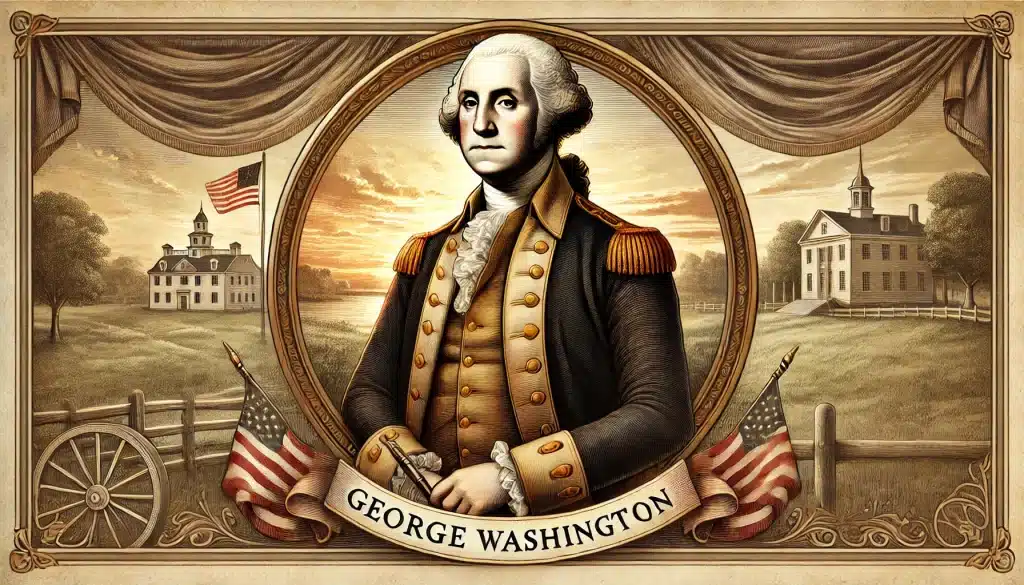
George Washington is synonymous with American independence, leadership, and nation birth. As the first President of the United States, Washington set a precedent for the office and laid the foundation for a fledgling republic. From 1732 to 1799, his life was marked by pivotal moments in American history, from the French and Indian War to the American Revolution and his presidency.
Early Life and Childhood
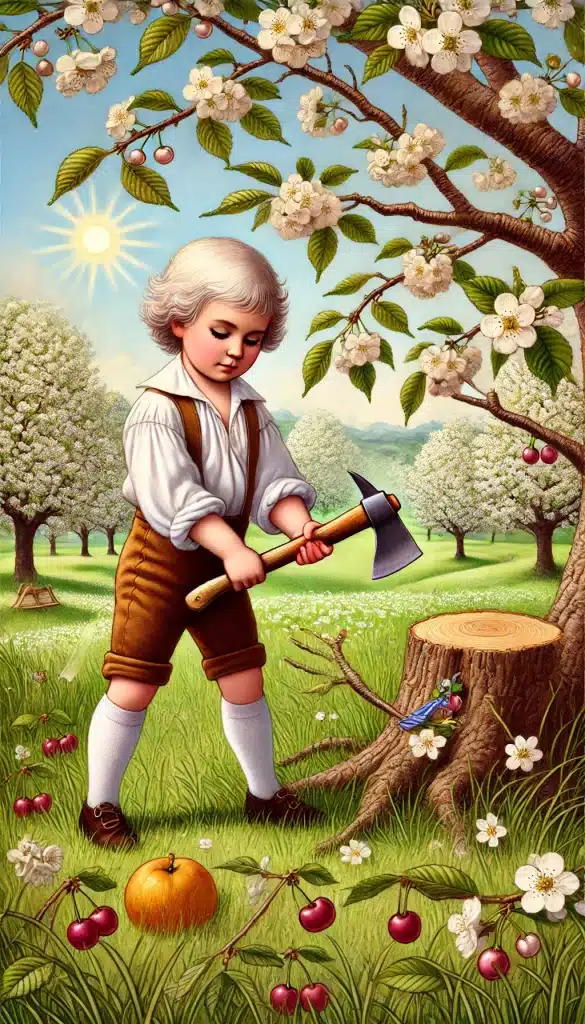
An illustration of young George Washington cutting down a cherry tree is based on the legendary tale.
George Washington was born to Augustine and Mary Ball Washington on February 22, 1732, in Westmoreland County, Virginia. As the eldest of six children in his father’s second marriage, George grew up on the family’s plantation. The Washingtons were moderately wealthy, owned land, and enslaved workers but were not part of Virginia’s elite class.
Young George’s education was basic and practical, focusing on mathematics, geography, and surveying. His formal education ended around age 15, after his father died in 1743. With limited schooling, Washington’s rise to prominence was predominantly self-made, driven by ambition, determination, and a keen sense of responsibility.
In his teenage years, Washington became an accomplished surveyor. This skill provided financial stability and deepened his understanding of the land, which would later prove invaluable in his military career. By the age of 17, he had secured a commission as the official surveyor of Culpeper County, Virginia.
The French and Indian War
Washington’s first foray into military leadership came during the French and Indian War (1754-1763), a conflict between Britain and France over control of North American territories. In 1753, at 21, Washington was appointed a major in the Virginia militia. His initial assignment was to deliver a message to the French demanding they vacate the Ohio Valley. The mission was unsuccessful, but it showcased Washington’s bravery and determination.
The following year, Washington’s leadership was tested at the Battle of Fort Necessity, where he commanded a small force against the French. Despite suffering defeat, his performance earned him recognition and a promotion to lieutenant colonel. Washington’s military experience during this war was a mix of triumphs and setbacks, but it taught him valuable lessons about leadership, strategy, and the complexities of colonial warfare.
By the war’s end, Washington had gained considerable respect for his courage and resilience. However, he grew frustrated with the British army’s treatment of colonial officers, a sentiment that would later fuel his support for American independence.
The American Revolution
Washington’s role in the American Revolution cemented his place in history as a national hero. In 1775, the Second Continental Congress appointed him as the Commander-in-Chief of the Continental Army. Washington’s leadership was instrumental in turning a loosely organized group of colonial militias into a cohesive fighting force.
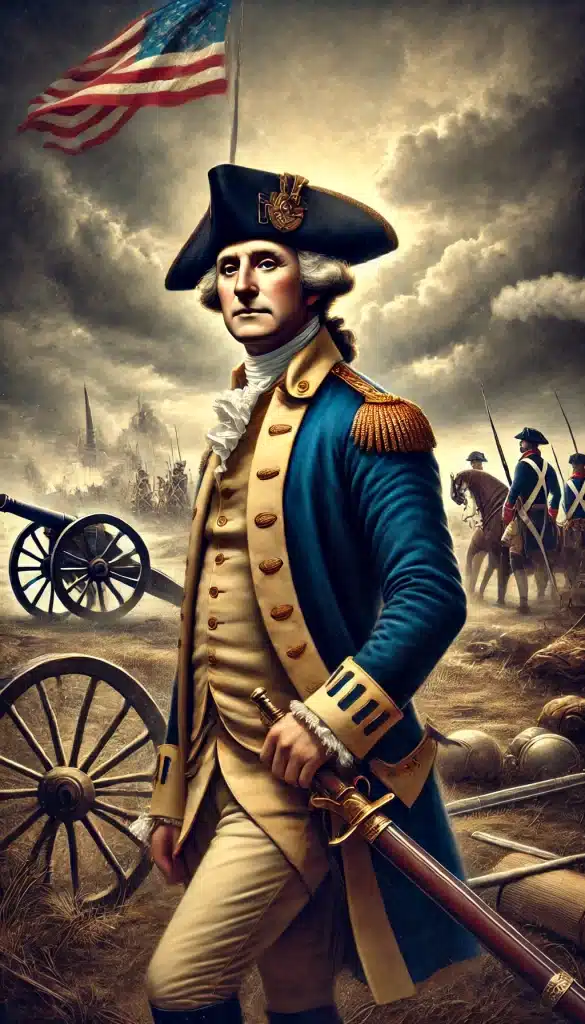
The Revolutionary War was a grueling eight-year struggle against the well-trained and well-equipped British army. Difficulties, including defeats, marked Washington’s early campaigns and struggles to maintain morale among his troops. However, his perseverance and strategic acumen turned the tide of the war. Key victories at Trenton (1776) and Princeton (1777) boosted American spirits and demonstrated Washington’s ability to outmaneuver the British.
Perhaps Washington’s most significant achievement was the Siege of Yorktown in 1781, when, with the aid of French forces, he orchestrated the surrender of British General Lord Cornwallis. This decisive victory effectively ended the war and secured American independence.
Throughout the conflict, Washington’s leadership extended beyond the battlefield. His ability to inspire loyalty and unity among his troops and his refusal to seize power after the war underscored his commitment to democratic ideals. In 1783, Washington resigned his commission, earning him international acclaim and solidifying his reputation as a faithful servant of the republic.
The Presidency
After the war, Washington wanted to retire to private life at his Mount Vernon estate. However, the fragile state of the new nation called him back into public service. In 1787, he presided over the Constitutional Convention in Philadelphia, where his leadership helped shape the U.S. Constitution. Two years later, Washington was unanimously elected as the first President of the United States, taking office in 1789.
Washington’s presidency was a period of significant challenges and achievements. As the first occupant of the office, he had no precedent to follow, and every decision set an example for future leaders. His administration established key institutions, including the federal judiciary and the Department of the Treasury. Washington also appointed Alexander Hamilton as the first Secretary of the Treasury, whose financial policies laid the groundwork for a stable national economy.
One of Washington’s most notable accomplishments was maintaining neutrality in foreign affairs, particularly during the conflict between Britain and France. His Proclamation of Neutrality in 1793 demonstrated his commitment to keeping the young nation out of entangling alliances, a principle he emphasized in his farewell address.
Domestically, Washington faced challenges such as the Whiskey Rebellion (1794), an uprising against a federal excise tax on whiskey. His decisive response, including mobilizing federal troops, reinforced the federal government’s authority.
After serving two terms, Washington declined to seek a third, setting a precedent for a peaceful transfer of power that became a cornerstone of American democracy. His farewell address, published in 1796, warned against political factionalism and foreign alliances, advice that remains relevant today.
Legacy
George Washington’s legacy extends far beyond his presidency. He is often called the “Father of His Country” for his indispensable role in establishing and guiding the United States. His leadership during the Revolutionary War and his presidency set the standard for future American leaders.
Washington’s Mount Vernon estate reflects his vision of American self-sufficiency and innovation. He pioneered agricultural practices, experimenting with crop rotation and other techniques to improve productivity. Today, Mount Vernon serves as a museum and a testament to his contributions to American society.
While Washington’s achievements are celebrated, his legacy is not without controversy. He was an enslaver, and his reliance on enslaved labor at Mount Vernon stands in stark contrast to the principles of liberty and equality he espoused. In recent years, there has been a growing effort to confront this aspect of his life and place it within the broader context of his contributions to the nation.
Conclusion
George Washington’s life story is about perseverance, leadership, and service. Washington’s actions shaped American history from his early days as a surveyor and soldier to his role as a revolutionary leader and the first President of the United States. His commitment to democratic principles, even in the face of immense challenges, established a legacy that continues to inspire.
As we reflect on Washington’s life, it is important to consider both his accomplishments and the complexities of his character. He was not a perfect man, but his vision, courage, and dedication to the ideals of liberty and self-governance laid the foundation for a nation that has endured for over two centuries. George Washington is a symbol of American independence and the pursuit of a more perfect union.
OpenAI. (2024). ChatGPT [Large language model]. https://chatgpt.com
