
Historic Events
The Thornton Affair: A Key Moment in U.S.-Mexico History
Jul
The Thornton Affair, also called the Thornton Skirmish, is an important event in the history of the United States and Mexico. It happened on April 25, 1846, and it was the beginning of the Mexican-American War. This war changed the maps and relationships between the two countries. This article will examine what led to the Thornton Affair, what happened, and how it affected both nations.
What Led to the Thornton Affair
A Disputed Border
Before the Thornton Affair, much arguing was about the border between the United States and Mexico. The U.S. had taken Texas in 1845, but Mexico did not accept that Texas was part of the U.S. There was also confusion about where the border should be. The U.S. said it was the Rio Grande River, while Mexico said it was the Nueces River. The land between these two rivers became a hot spot for trouble.
President Polk’s Goals
President James K. Polk believed in Manifest Destiny, which meant he thought the U.S. should spread across North America. He wanted to add Texas, California, and New Mexico to the U.S. Polk tried to buy these lands from Mexico, but Mexico refused to talk because they were angry about Texas. So, Polk sent General Zachary Taylor and his troops into the disputed area, which made things tense with Mexico.
The Thornton Affair: A Dangerous Meeting
The Skirmish
On April 25, 1846, Captain Seth Thornton led a group of 70 U.S. soldiers to explore the area near the Rio Grande. They soon found themselves facing about 2,000 Mexican soldiers led by General Anastasio Torrejón. Outnumbered, the American soldiers quickly got into a fight.
Casualties and Captivity
In this battle, 16 American soldiers lost their lives, and the Mexican forces captured the rest. This was the first time American blood was shed in what would become a larger war.
News in Washington
When President Polk heard about the fight, he used it to say that Mexico was starting trouble. On May 11, 1846, he spoke to Congress and claimed that Mexico had invaded U.S. land. This helped him gain support for declaring war.
The Mexican-American War
Declaring War
On May 13, 1846, Congress officially declared war on Mexico. Many people supported the war, but some were against it, especially those in the North who didn’t want slavery to spread to new territories.
Major Battles
During the Mexican-American War, there were important battles, including:
- General Zachary Taylor’s Campaign: He won big Monterrey and Buena Vista battles.
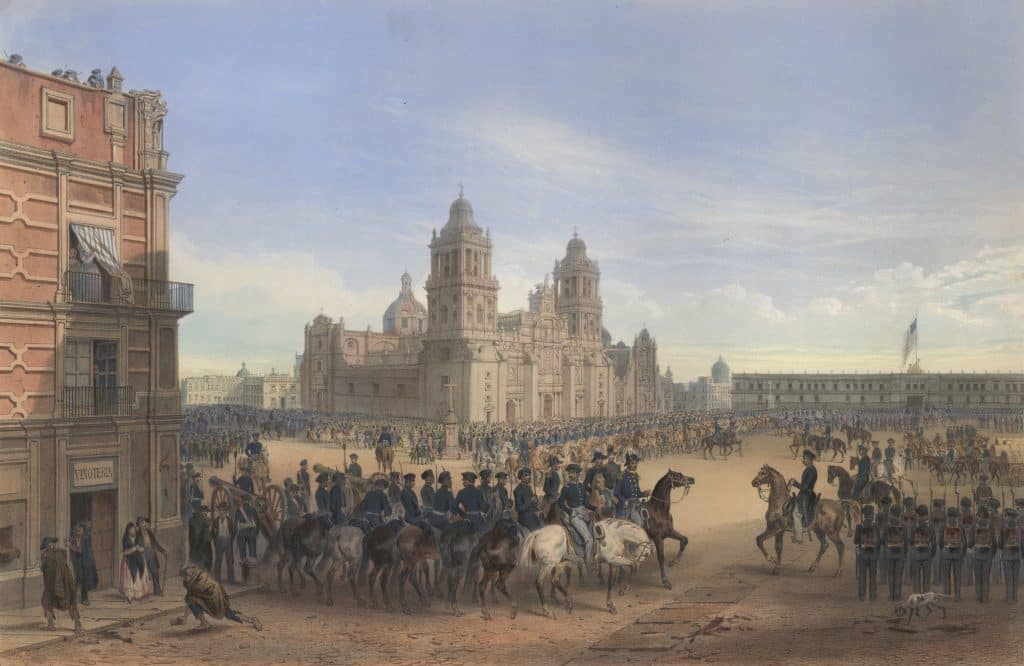
- General Winfield Scott’s March: He captured Mexico City in September 1847.
- The California Campaign: This brought California under U.S. control.
The Treaty of Guadalupe Hidalgo
The war ended on February 2, 1848, with the Treaty of Guadalupe Hidalgo. In this agreement, Mexico gave up a lot of land, including what is now California, Arizona, and New Mexico, to the U.S. In return, the U.S. paid Mexico $15 million.
The Impact of the Thornton Affair
Changing U.S.-Mexico Relations
The Thornton Affair was a key moment that led to the Mexican-American War. The war’s outcomes changed both countries’ borders and created new challenges and alliances between the U.S. and Mexico.
Manifest Destiny Achieved
This war helped achieve the goals of Manifest Destiny, but it also brought up arguments about slavery, which would later lead to the American Civil War.
A Controversial War
Historians still debate whether the U.S. caused the Thornton Affair to justify its expansion plans. Some think it resulted from unresolved issues between the two countries.
Conclusion
The Thornton Affair is an important event in U.S.-Mexico history. It started the Mexican-American War and changed the land in North America. We can better understand how countries interact, negotiate, and sometimes conflict by looking at what happened before, during, and after this event. The Thornton Affair reminds us that even small events can lead to big changes in history.
