
Actors
Charlton Heston: A Towering Figure in Cinema and Beyond
Sep
Charlton Heston, born John Charles Carter, was an actor whose career spanned over six decades, leaving an indelible mark on Hollywood and American culture. Known for his commanding presence, chiseled features, and resonant voice, Heston became synonymous with epic historical dramas, often portraying larger-than-life figures who shaped the course of human events. Beyond his iconic roles, Heston was a complex and frequently controversial figure, deeply involved in political activism and social causes, making his life story as dramatic and compelling as any film he starred in.
The Early Years and Charlton Heston’s Rise to Stardom
Born in Evanston, Illinois, in 1923, Heston’s early life was marked by his parents’ divorce and a move to St. Helen, Michigan, where he developed a love for the outdoors and an early interest in acting. He attended Northwestern University on a drama scholarship, where he met his future wife, Lydia Clarke, with whom he would share a lifelong partnership. His early career saw him honing his craft in theater, including Broadway, before leaping into film.
Heston’s breakthrough came in 1952 with Cecil B. DeMille’s “The Greatest Show on Earth,” a sprawling circus epic that won the Academy Award for Best Picture. This film showcased his rugged appeal and ability to command the screen, setting the stage for the roles that would define his career.
The King of Epics: Crafting a Legacy
It was DeMille who truly recognized Heston’s potential for grand historical roles. In 1956, he cast Heston as Moses in “The Ten Commandments.” This role cemented Heston’s status as an epic hero. His portrayal of Moses, from a defiant prince to a divinely inspired prophet leading his people to freedom, became iconic, with the image of him parting the Red Sea etched into cinematic history.
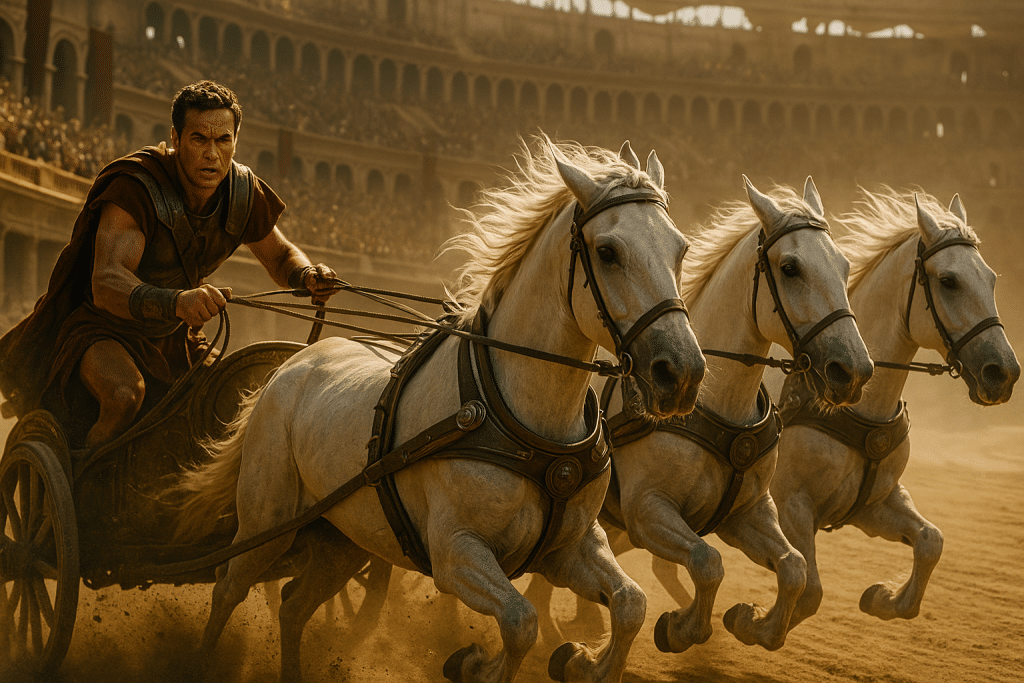
The success of “The Ten Commandments” led to a string of similarly monumental roles. In 1959, he starred as the titular character in William Wyler’s “Ben-Hur,” a performance that earned him an Academy Award for Best Actor. The film, a grand spectacle set in ancient Rome and Judea, is celebrated for its breathtaking chariot race, a sequence that remains one of cinema’s most thrilling. Heston’s portrayal of Judah Ben-Hur, a Jewish prince betrayed into slavery who finds redemption and revenge, perfectly captured the film’s themes of faith, betrayal, and freedom.
Beyond these two biblical epics, Heston continued to dominate the genre, starring in films like “El Cid” (1961), in which he played the legendary Spanish knight, and “Khartoum” (1966), which depicted the British General Charles “Chinese” Gordon. His ability to embody historical and mythical figures with gravitas and conviction made him the go-to actor for films of this scale.
Beyond the Toga: Sci-Fi and Diverse Roles
While often associated with historical epics, Heston’s career was far from limited. He demonstrated his versatility in a range of genres, most notably in science fiction, where he starred in several films that have since achieved cult status and critical acclaim.
“Planet of the Apes” (1968) stands out as a landmark science fiction film and a critical turning point in Heston’s career. His role as astronaut George Taylor, who crashes on a mysterious planet ruled by intelligent apes, showcased his dramatic range, culminating in one of the most famous twist endings in cinematic history. The film’s themes of evolution, society, and humanity’s destructive nature resonated deeply with audiences and critics.
He followed this with other notable sci-fi features, including “The Omega Man” (1971), where he played a scientist immune to a global plague, and “Soylent Green” (1973), a dystopian thriller with another shocking conclusion that explored environmental and social collapse. These films cemented his status not just as an epic hero but also as a compelling figure in speculative fiction, often portraying humanity’s last bastion against overwhelming odds.
A Voice for Change: Activism and Politics
Heston’s impact extended far beyond the silver screen. He was a passionate and articulate voice in American politics and social movements, initially aligning himself with liberal causes before gradually shifting towards conservatism.
In the 1960s, Heston was a vocal supporter of the Civil Rights Movement. He marched with Martin Luther King Jr. in Washington, D.C., in 1963 and was actively involved in advocating for racial equality. His commitment to social justice was evident in his willingness to use his platform to push for change during a turbulent period in American history.
However, as the political landscape evolved, so did Heston’s views. He became increasingly conservative, a trajectory that would define his later public life. He was initially a prominent opponent of the Vietnam War, but later expressed regret for his stance. His best-known political role was as president of the National Rifle Association (NRA) from 1998 to 2003. During his tenure, he became a fierce advocate for gun rights, famously declaring, “From my cold, dead hands!” in reference to gun confiscation.
His political stances, particularly his leadership of the NRA, made him a controversial figure, drawing both fervent admiration and intense criticism. Regardless of one’s agreement with his politics, Heston’s unwavering commitment to his beliefs and willingness to engage in public discourse demonstrated a man deeply invested in his country’s direction.
A Life Well-Lived: Later Career and Legacy
In his later years, Heston continued to work, though at a slower pace. He made appearances in various films and television shows, often in cameo roles or as a narrator, his iconic voice instantly recognizable. He also dedicated time to writing, publishing several memoirs and reflections on his career and life.
In 2002, Heston publicly announced his diagnosis with Alzheimer’s disease, a poignant moment for a man whose intellect and commanding presence had been so central to his public persona. He passed away in 2008 at the age of 84, leaving behind a monumental body of work and a legacy that continues to be debated and celebrated.
Charlton Heston was more than just an actor; he was a cultural phenomenon. His portrayals of heroic figures, from Moses to Ben-Hur to Taylor, tapped into a collective human desire for leadership, justice, and survival. He embodied a certain ideal of American masculinity – strong, principled, and unafraid to stand for what he believed in.
His career mirrored the shifting tides of Hollywood, from the golden age of studio epics to the rise of science fiction, and his personal journey reflected the evolving political landscape of America. Charlton Heston remains a towering figure, not only for the unforgettable characters he brought to life on screen but also for the complex, passionate, and influential man he was in real life. His films continue to entertain and provoke thought, ensuring that his “cold, dead hands” will forever hold a firm grip on cinematic history.
