
Civil Rights
Elizabeth Cady Stanton: A Pioneer of Women’s Rights

Jan
Elizabeth Cady Stanton is one of the most influential figures in American history, and she was celebrated for her tireless advocacy for women’s rights and pivotal role in the early suffrage movement. Born in 1815, Stanton’s life and legacy are a testament to her intellect, determination, and commitment to social reform. Her work laid the foundation for the eventual passage of the 19th Amendment, challenged societal norms, and inspired generations of activists. This blog post explores the life, achievements, and enduring impact of Elizabeth Cady Stanton.
Early Life and Influences
Elizabeth Cady Stanton was born to a prominent family in Johnstown, New York, on November 12, 1815. Her father, Daniel Cady, was a lawyer and judge, and her mother, Margaret Livingston Cady, was a descendant of the Livingston family, known for their wealth and influence. Despite growing up in a privileged household, Stanton’s early experiences exposed her to the legal and social injustices women face.
Stanton’s intellectual curiosity was evident from a young age. Although women were not encouraged to pursue formal education, she benefited from her father’s extensive law library, where she read legal texts and observed how the law marginalized women. She also attended the Troy Female Seminary, one of the few educational institutions for women at the time. Her education fostered a lifelong passion for justice and equality.
Exposure to the abolitionist movement significantly influenced Stanton’s activism. Her cousin, Gerrit Smith, was a prominent abolitionist, and her future husband, Henry Brewster Stanton, was an anti-slavery activist. Their involvement in social reform shaped her understanding of systemic oppression and inspired her to advocate for women’s rights.
The Birth of a Movement: Seneca Falls Convention
1840, Elizabeth Cady Stanton married Henry Brewster Stanton and traveled to London for the World Anti-Slavery Convention. There, she met Lucretia Mott, a Quaker and fellow activist. Both women were outraged when they were barred from participating in the convention because of their gender. This experience ignited their determination to address women’s rights.
Eight years later, Stanton and Mott organized the Seneca Falls Convention in Seneca Falls, New York, the first women’s rights convention in the United States. Held on July 19-20, 1848, the convention marked a turning point in the fight for gender equality. Stanton drafted the Declaration of Sentiments, a groundbreaking document modeled after the Declaration of Independence. It boldly declared that “all men and women are created equal” and listed grievances highlighting the legal and societal injustices faced by women, including their lack of voting rights, educational opportunities, and control over property.
The Declaration of Sentiments concluded with a resolution demanding women’s suffrage, a controversial stance at the time. While the resolution was met with resistance, it was adopted and became a central focus of the women’s rights movement. Stanton’s courage in advocating for women’s right to vote set the stage for decades of activism.
Partnership with Susan B. Anthony
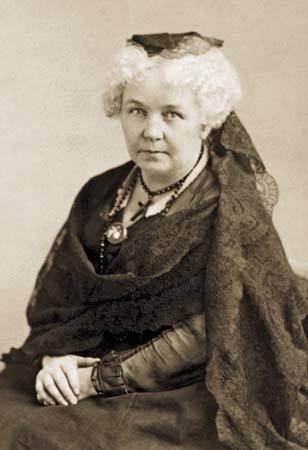
One of the most significant relationships in Stanton’s life was her partnership with Susan B. Anthony. The two women met in 1851 and quickly formed a close friendship and collaborative bond. While Stanton excelled at writing speeches, drafting legislation, and formulating arguments, Anthony was a skilled organizer and public speaker. Together, they became the dynamic duo of the women’s suffrage movement. In 1869, Stanton and Anthony founded the National Woman Suffrage Association (NWSA), an organization dedicated to securing a constitutional amendment for women’s voting rights.
Unlike other suffrage groups, the NWSA addressed broader issues, including divorce reform and women’s access to education and employment. Stanton’s willingness to tackle controversial topics sometimes alienated more conservative activists, but it underscored her commitment to comprehensive social reform.
Expanding the Agenda: “The Woman’s Bible”
In addition to her work on suffrage, Elizabeth Cady Stanton challenged traditional interpretations of women’s religious roles. In the late 19th century, she began work on “The Woman’s Bible,” a two-volume critique of how religious texts had been used to justify women’s subjugation. Published in 1895 and 1898, the work examined biblical passages and offered alternative interpretations emphasizing gender equality.
“The Woman’s Bible” was highly controversial, even within the suffrage movement. Some leaders feared it would alienate religious supporters, and the National American Woman Suffrage Association (NAWSA) formally disavowed it. However, Stanton’s bold critique of religious orthodoxy reflected her broader vision of liberation, encompassing legal rights and cultural and spiritual freedom.
Legacy of Activism
Elizabeth Cady Stanton’s contributions extended far beyond her lifetime. With Susan B. Anthony and others, she co-authored the History of Woman Suffrage, which documents the movement’s history and achievements. This comprehensive work remains a valuable resource for understanding the struggles and triumphs of early feminists.
Despite her tireless efforts, Stanton did not live to see women gain the right to vote. She died on October 26, 1902, nearly two decades before the 19th Amendment was ratified in 1920. However, her vision and advocacy were instrumental in paving the way for this historic achievement.
Enduring Impact
Elizabeth Cady Stanton’s legacy is profound and far-reaching. She challenged the status quo, questioned deeply ingrained societal norms, and inspired a movement that transformed American democracy. Her work demonstrated the power of intellect, collaboration, and persistence in adversity.
Today, Stanton is remembered as a trailblazer who dared to envision a world where women and men are truly equal. Her writings, speeches, and activism continue to inspire advocates for gender equality and social justice around the globe. Examining her life and achievements reminds us of the importance of courage, conviction, and the enduring fight for human rights.
Conclusion
Elizabeth Cady Stanton’s life is a testament to the power of determination and the transformative impact of advocacy. Her efforts, from the Seneca Falls Convention to her partnership with Susan B. Anthony, laid the groundwork for monumental changes in American society. At the same time, she did not live to see the fruits of her labor; her vision and legacy endured as a beacon of hope and progress.
Elizabeth Cady Stanton’s story powerfully reminds us that change often begins with a single voice challenging the status quo. Her work inspires us to fight for equality and justice in all forms, ensuring that her vision of a fair and equitable society remains a goal worth pursuing.
OpenAI. (2025). ChatGPT [Large language model]. https://chatgpt.com
